

Blog > Rates Creeping Back Up? Negotiate Beyond the Rate
Oct. 28, 2026
I’ve been through enough rate cycles to know how quickly rising-rate headlines can make buyers anxious. Here’s what I tell buyers: you may not control the market rate, but you can shop lenders and negotiate other parts of the offer.
Rates rose through much of this fall, though the latest weekly average eased slightly. Freddie Mac’s national average for a 30-year fixed mortgage went from 6.65% on Aug. 20 to 7.40% on Oct. 8 and 15, then dipped to 7.32% on Oct. 22. Those are survey averages, not individual loan quotes.
What can change your payment?
A seller credit is an amount the seller agrees to contribute toward eligible costs at closing. Depending on the loan program, it may help pay closing costs, discount points, or a temporary payment subsidy such as a 2-1 buydown. The seller has to agree, and program rules set limits on how credits can be used.
For a 30-year fixed loan near 7.3%, reducing the loan balance by $10,000 lowers principal-and-interest payments by about $68 per month. A $10,000 reduction in the home price usually reduces the loan balance by less than $10,000 if the buyer keeps the same down-payment percentage. For example, with 20% down, a $10,000 price reduction means an $8,000 smaller loan, or about $55 less in monthly principal and interest.
A temporary 2-1 buydown can create a larger reduction in the borrower’s monthly payment during the first two years, but it has an upfront cost and the payment returns to the full note-rate amount afterward. In the example below, the estimated subsidy is about $11,786. That’s different from a price reduction, which lowers the amount borrowed over the loan term.
How does a 2-1 buydown work?
A 2-1 buydown temporarily subsidizes a buyer’s payments for two years. It does not change the interest rate written into the mortgage note.
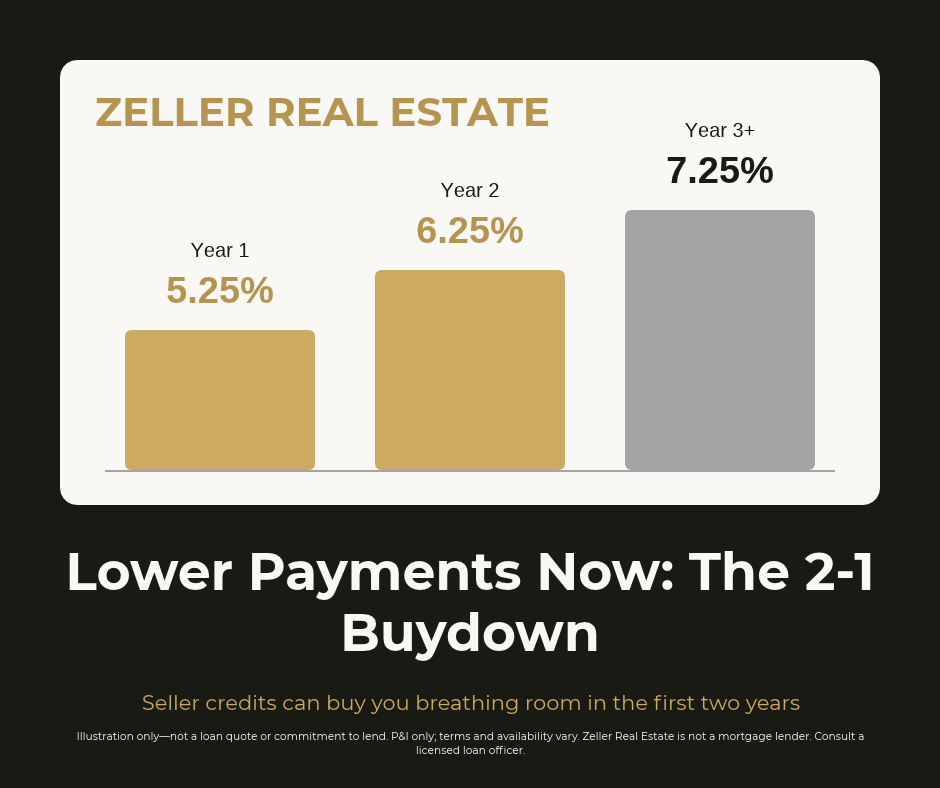
Here’s an illustration using a $500,000, 30-year fixed loan with a 7.25% note rate:
Year 1: Payment equivalent to 5.25%; about $2,761/month in principal and interest, or about $650/month less than the full note-rate payment.
Year 2: Payment equivalent to 6.25%; about $3,079/month in principal and interest, or about $332/month less.
Year 3 and after: Full note-rate payment at 7.25%; about $3,411/month in principal and interest.
The estimated cost of the two-year subsidy is about $11,786, or roughly 2.4% of the loan amount. The funds are set aside and applied toward the payment difference under the buydown agreement. Ask the lender how the subsidy works for the specific loan and what happens to any unused funds if the loan is paid off early.
Does a 2-1 buydown help you qualify?
A temporary buydown generally doesn’t let a buyer qualify using the lower first-year payment. For example, Fannie Mae requires borrowers to qualify at the note rate for loans with temporary buydowns. Rules can vary by loan program, so confirm the qualifying payment with the lender.
2-1 buydown vs. permanent buydown: what’s the difference?
A 2-1 buydown temporarily reduces payments for the first two years. A permanent buydown uses discount points to lower the loan’s note rate for as long as the loan remains in place. Neither option is automatically better.
Temporary 2-1 buydown: Subsidizes payments for the first two years, then the payment returns to the full note-rate amount.
Can provide short-term cash-flow relief, with an upfront subsidy cost.
Usually doesn’t let the borrower qualify using the reduced payment.
Treatment of unused funds after an early payoff depends on the loan program and agreement.
May suit buyers who can afford the full payment and value lower payments at the start of the loan.
Permanent buydown: Lowers the note rate for the life of the loan, unless the loan is paid off or refinanced.
Usually gives a smaller payment reduction each month, for longer.
May reduce the qualifying payment, depending on the loan and lender.
Discount points are an upfront cost and generally aren’t refunded if the borrower pays off the loan early.
May suit buyers who expect to keep the loan long enough for the savings to outweigh the upfront cost.
Ask the lender to compare the cost, payment, and break-even point for each option. Don’t rely on a future refinance or income increase to make the full payment affordable.
Why involve your lender before writing an offer?
Seller-credit limits and eligible uses depend on the loan program. These are general guidelines for primary-residence purchases; your lender can confirm which rules apply to your loan.
Loan program: General seller-credit guideline
Conventional: For Fannie Mae loans, up to 3% when LTV is over 90%; 6% when LTV is over 75% through 90%; and 9% at 75% LTV or less. Limits are based on the lower of the sale price or appraised value.
FHA: Up to 6% of the sale price toward eligible costs, including discount points and temporary buydowns.
VA: The 4% cap applies to seller concessions. Certain allowable seller-paid closing costs are handled separately.
USDA: Seller contributions are generally limited to 6% of the sale price and must be used for eligible loan purposes.
A credit can’t be paid to the buyer as extra cash. Program rules may limit it to eligible costs and specify how an excess is handled. If an offer price is adjusted to account for seller credits, the appraisal and loan-to-value requirements still apply.
That’s why I recommend involving your lender before writing an offer. Your lender can calculate the cost of a buydown, confirm the credit limit for your loan, and show how each option changes your payment.
What should buyers in El Dorado County consider?
Higher rates can change the offer strategy, but they don’t make every seller credit or buydown worthwhile. I help buyers think through how seller credits fit into an offer; a licensed loan officer can confirm the loan terms, payment, and program limits.
If you’re thinking about buying in El Dorado County, send me your price range and I’ll help you consider what to discuss with your lender.
Zeller Real Estate is not a mortgage lender. Rate and payment examples are for illustration only and are not a commitment to lend. Loan terms, seller credit limits and buydown availability vary by lender and program. Talk with a licensed loan officer about your situation.